


AI solutions designed from your company's real work.
An SME does not buy “artificial intelligence” in the abstract. Usually it has a sales department to speed up, documents to check, customers to follow better, reports to produce with less effort, internal procedures to make accessible or sensitive data to manage with more control.
That is why the first job is not choosing the most famous model, but understanding the use case: which data is needed, who uses the tool, how autonomous it must be, which errors are unacceptable, which operating budget is sustainable and whether cloud, local or hybrid architecture makes sense.
How to choose the right solution
The same problem can require different tools. First we interpret the need, then we decide the architecture.
Objective
What must improve: time, quality, control, support, sales, analysis or governance.
Available data
Documents, email, sheets, databases, CRM, manuals, price lists or external sources to connect.
Risk
What AI can do on its own and what must remain under human review.
Operating cost
Usage volume, selected model, infrastructure and monthly sustainability.
An AI agent is not just a chatbot that answers better.
A chatbot converses. An AI agent, if well designed, can follow an objective, read context, use external tools, apply rules, produce a result and stop when a check is required.
For a company, the difference is practical: it is not just about generating text, but building operational support that works inside a defined process.
It manages multi-step flows
It can receive an input, interpret it, retrieve data, compare sources and prepare a controllable output.
It uses external tools
It can connect to APIs, databases, sheets, email, document repositories and business applications.
It works with controls
It can use checklists, thresholds, logs, cited sources and review steps to reduce fragile answers.
It remains governable
Sensitive actions can be set as “draft”, “suggestion” or “to be approved”.
First we understand the work to improve, then we decide which AI to use.
A useful solution is created when we connect a business need to a measurable result: less time to prepare a quote, fewer document errors, faster onboarding, more consistent customer responses, clearer management reports or greater control over sensitive data.
Quotes and sales requests
Sales must read a request, identify the correct product, check availability, conditions, attachments and customer history.
Possible solution: an agent that prepares a complete draft, flags missing data and suggests which documentation to attach.
Administration and fiscal documents
Invoices, orders, delivery notes, expense reports or contracts arrive in different formats and require extraction, classification and control.
Possible solution: a system that reads files, extracts key fields, highlights anomalies and prepares a review table.
Customer support and after-sales
Many requests are not simple FAQs: they require consulting procedures, warranties, manuals, terms and previous cases.
Possible solution: an internal assistant that suggests consistent answers and shows the team the sources used.
Marketing, content and campaigns
Data, trends, competitors, advertising results and existing content must be turned into operational decisions.
Possible solution: an agent that gathers sources, proposes insights, organizes editorial plans and prepares periodic reports.
Production, warehouse and logistics
Orders, inventory, deliveries, complaints and transport documents can create delays if they are not read together.
Possible solution: a workflow that detects inconsistencies, alerts the manager and produces a summary of operational status.
Onboarding and internal training
New collaborators, updated procedures and company knowledge take time before they become real autonomy.
Possible solution: an internal knowledge assistant that answers using company materials and guides the team through the correct steps.

Technology changes according to flow, risk and budget.
Sometimes an autonomous agent is needed, other times controlled RAG, simple automation, tool integration or a local solution. The difference comes from the context and the level of responsibility we want to assign to the system.
Operational AI agents
Specialized systems that follow an objective and use several steps: analysis, data retrieval, generation, control and delivery of the result.
Example: an agent that receives a technical request, identifies the product, prepares a commercial response and asks for approval before sending.
Learn moreRAG systems and knowledge bases
They make company documents, procedures, manuals, contracts and technical materials queryable, with answers based on uploaded files.
Example: a technical department quickly consults product sheets and operating instructions, with references to sources.
Explore RAGDocument intelligence
Reading, extraction, normalization and verification of complex documents: PDFs, images, forms, contracts, reports, invoices and attachments.
Example: a system that recognizes a contract, extracts deadlines, amounts, relevant clauses and points to verify.
View a case studyAPI, MCP and workflow integrations
They connect Drive, Docs, Sheets, Gmail, CRM, databases, management systems or external services to avoid manual steps between systems.
Example: an email request generates a customer record, updates a sheet, attaches documents and creates a draft response.
View AI agentsAnalysis, reports and decision support
They turn internal data, external sources, benchmarks and indicators into readable summaries for marketing, management, sales or operations.
Example: a monthly report highlighting performance changes, anomalies, priorities and recommended actions.
View an exampleLocal, private or on-premise AI
Solutions installed on PCs, laptops, workstations or company servers when privacy, continuity and data control matter more than cloud convenience.
Example: medical practice, legal office or finance company that works on confidential documents and wants to minimize exposure to external services.
Explore the approachApplication examples for different sectors and departments.
These are not standard packages, but useful scenarios for understanding how a business need becomes a realistic technical solution.
B2B distributor
Receives requests with incomplete product codes, variants, commercial terms and technical documentation to attach.
Application: a sales agent that proposes a response, attachments and compatible alternative products.
Professional firm
It must read client documents, track deadlines and prepare consistent summaries for different cases.
Application: a document assistant with data extraction, checklists and a synthetic case file for review.
Clinic or outpatient center
It has procedures, consents, patient communication, administrative documents and data protection needs.
Application: a local or controlled system for internal consultation, informational triage and front-office support.
Manufacturing company
Works with product sheets, manuals, non-conformities, quality documents and customer technical requests.
Application: a technical knowledge base that helps operators, quality teams and technical sales find documented answers.
Marketing agency
Manages research, editorial plans, client reports, competitor analysis and strategic documentation.
Application: an agent that gathers sources, structures insights, prepares drafts and produces reports with verifiable sources.
E-commerce or retail
It must update product sheets, answer requests, analyze reviews and interpret sales data.
Application: an agent for catalog, customer insight, product descriptions and analysis of the most frequent questions.
Real estate and local services
Manages property sheets, lead requests, documents, appointments and communication with different clients.
Application: an assistant that qualifies requests, prepares sheets, summarizes appointments and updates the CRM.
HR and corporate training
Internal procedures, policies, onboarding materials and employee questions can be organized better.
Application: an internal assistant that guides new hires and supports managers and teams with procedures.
The cost of an AI solution is not only development: consumption must also be designed.
If cloud models such as ChatGPT, Gemini or Claude are used, the cost varies according to the provider, the selected model and usage volume. The most important unit to consider is the token: a portion of text used to calculate the model's input and output.
That is why an initial study makes sense: how many requests per day, how many documents, average response length, how many people will use the system, which functions require more powerful models and which can use cheaper models.
Cloud AI: variable pay-per-use cost
ChatGPT/OpenAI, Gemini and Claude have different price lists and often distinguish between input tokens, output tokens, fast models, more powerful models, embeddings, images or advanced functions. A good architecture uses the right model for each step, records consumption and sets monthly limits.
Local or on-premise AI
Once the model is installed on a PC, laptop, workstation or company server, there are no per-token API costs paid to an external provider. Real hardware, maintenance and electricity costs remain.
Electricity consumption: kWh
For local machines the energy measurement unit is the kilowatt-hour, kWh. Consumption depends on CPU, GPU, usage time, model load and server configuration.
Economic feasibility study
Before development, it is useful to estimate monthly scenarios: light use, medium use, intensive use. This makes it possible to decide whether a cloud model, a local solution or a combination is best: cloud for the most complex tasks and local for recurring activities or sensitive documents.
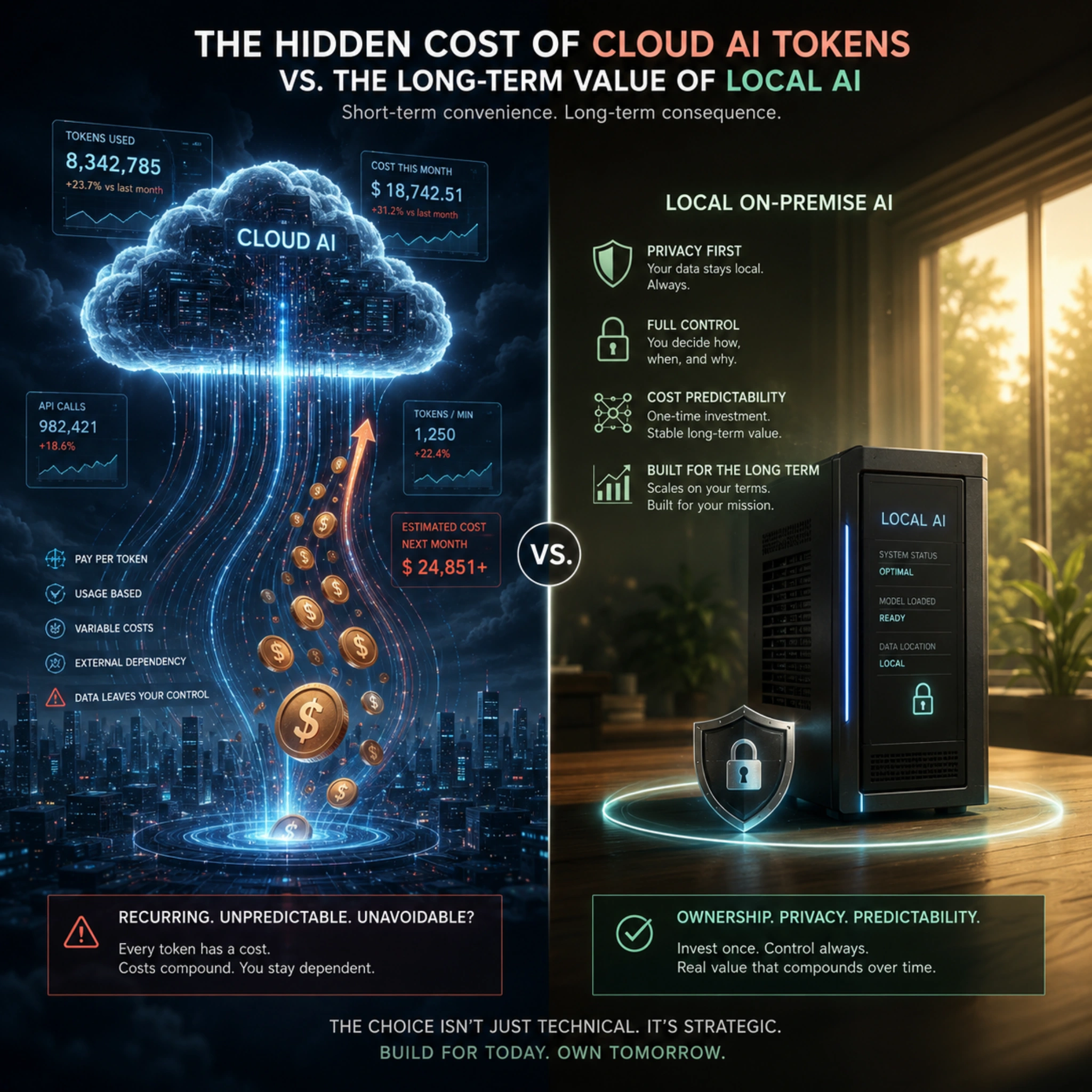
The hidden cost of cloud tokens must be governed before it becomes structural.
AI agents based only on cloud APIs are convenient to start, but every request has a cost. When usage grows, input tokens, output tokens, embeddings, repeated calls and scheduled automation can generate recurring spending that is hard to predict.
For many companies, the best solution is not to choose ideologically between cloud and local, but to design a hybrid architecture: cloud for steps that require more powerful models, on premise for sensitive documents, repetitive activities and high-volume flows. This reduces external dependency, data exposure and variable costs.
Privacy
Critical data can remain on company infrastructure.
Predictability
Cost does not depend only on the number of requests generated by users.
Control
Models, permissions, logs and usage limits are designed upfront.
An AI solution makes sense when it produces a verifiable advantage.
Not everything needs to become an agent. Sometimes a clearer process, targeted training or small automation is enough. Custom AI is appropriate when the benefit is concrete and the system can be governed.
Measurable value
Hours saved, better quality, reduced response times, fewer errors or greater operational continuity.
Available data
The system needs useful sources: documents, databases, procedures, examples, rules or integrations.
Controllable risk
Important actions must have logs, limits, human approval and clear responsibilities.
Realistic adoption
The tool must be simple to use and compatible with the way the team already works.
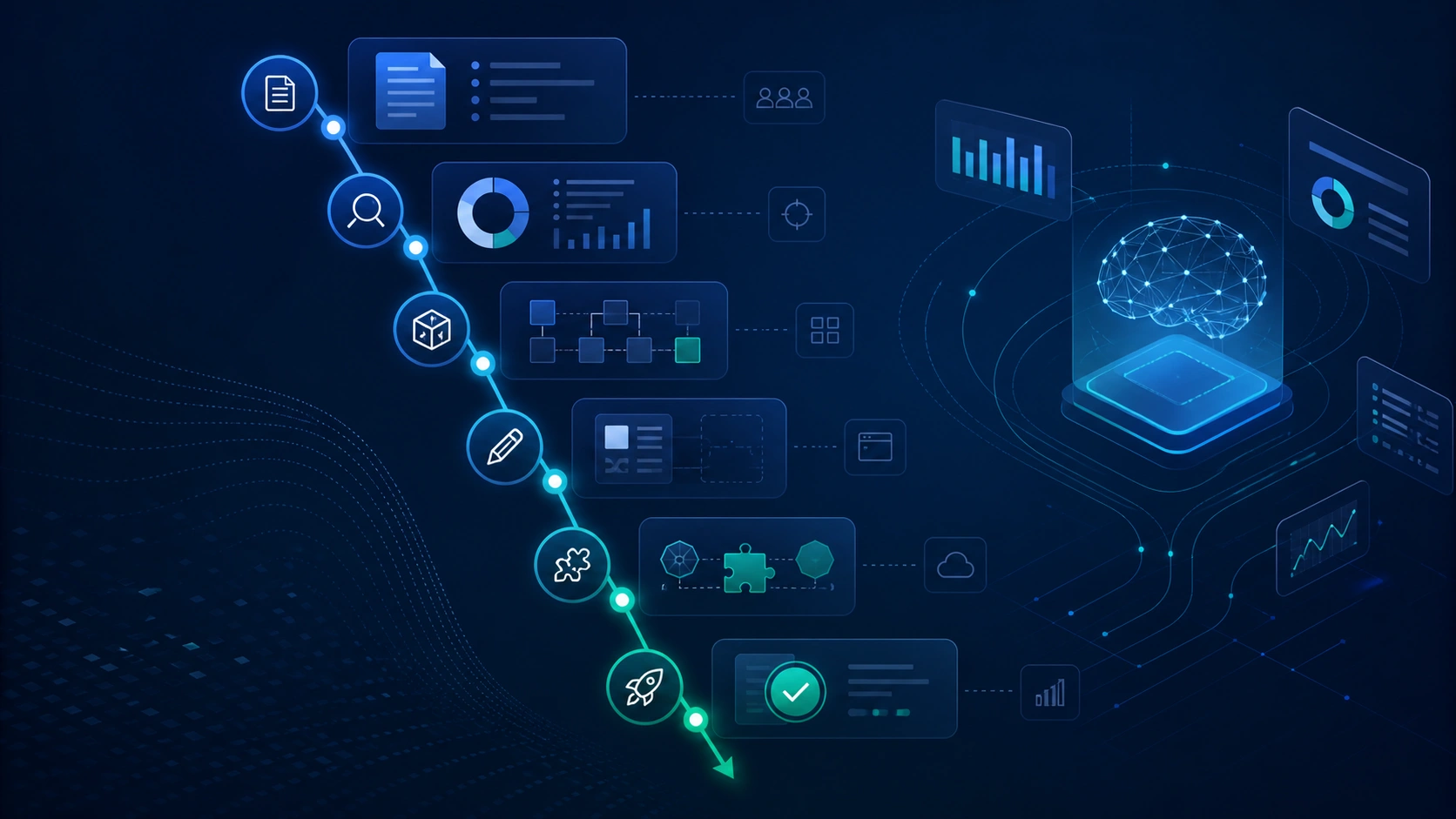
The project is built in clear phases, with an initial document, a sensible technological choice and real investment control.
The goal is not to “make an AI agent” in the abstract, but to understand what the company really needs, how to integrate it into daily work and how much it makes sense to spend. That is why the path starts from an operational PRD, moves through technical and economic assessments, and reaches release only after concrete validation.
PRD and objective
What it consists of
It starts from a clear and concise design document: problem to solve, department involved, users, expected results, constraints, data already available and operational priorities. It helps avoid confused or overly generic projects.
- definition of the use case and responsibilities
- project boundaries and success criteria
- first snapshot of expected value
What it consists of
We study how the company really works: documents, manual steps, software already used, timing, volumes, bottlenecks and frequent errors. Here we understand whether support, automation or a higher level of autonomy is needed.
- map of data, procedures and integrations
- check of quality, security and source availability
- distinction between simple automation, assistance and autonomy
Operational analysis
AI model, architecture and costs
What it consists of
We choose whether to use ChatGPT, Gemini, Claude or a local/on-premise model. The decision depends on required quality, privacy, speed, integrations, budget and expected usage volume over time.
- estimate of API costs based on tokens, users and volumes
- evaluation between cloud, local or hybrid approach
- choice of guardrails, logging and level of human control
What it consists of
A first version of the system is built and tested on realistic cases. It is not a demo for its own sake: it is used to verify whether the flow really works, how much time it saves and whether the numbers make sense.
- testing on realistic or anonymized data
- verification of output and exceptions
- comparison between expected ROI, timing and sustainability
Prototype and economic validation
Integration and governance
What it consists of
When the prototype is valid, the system is connected to the company's real tools and inserted into the daily flow. Here roles, permissions, approvals, fallbacks and operational responsibilities are defined.
- connection to email, CRM, Drive, databases, APIs or ERP
- authorization, audit and supervision rules
- preparation for daily team use
What it consists of
Release does not close the project. Usage is monitored, the team is trained, logs and feedback are read and the system improves over time. This is where the solution stops being an experiment and becomes a real business tool.
- progressive release and performance control
- minimum training for users and internal contacts
- iterative improvements to prompts, rules and models
Release, training and improvement
In practice: technology is chosen after understanding the objective, data, usage frequency, risk and budget. In many cases the difference between a sustainable project and an expensive one lies here: deciding in advance which model to use, how many tokens it will consume and when it is better to move everything to a local machine or company server.
Do you want to understand which solution makes sense for your company?
Describe the case: process, department, documents, users, constraints and objective. From there we can understand whether you need an AI agent, RAG, an integration, a local solution or simply a lighter intervention.